
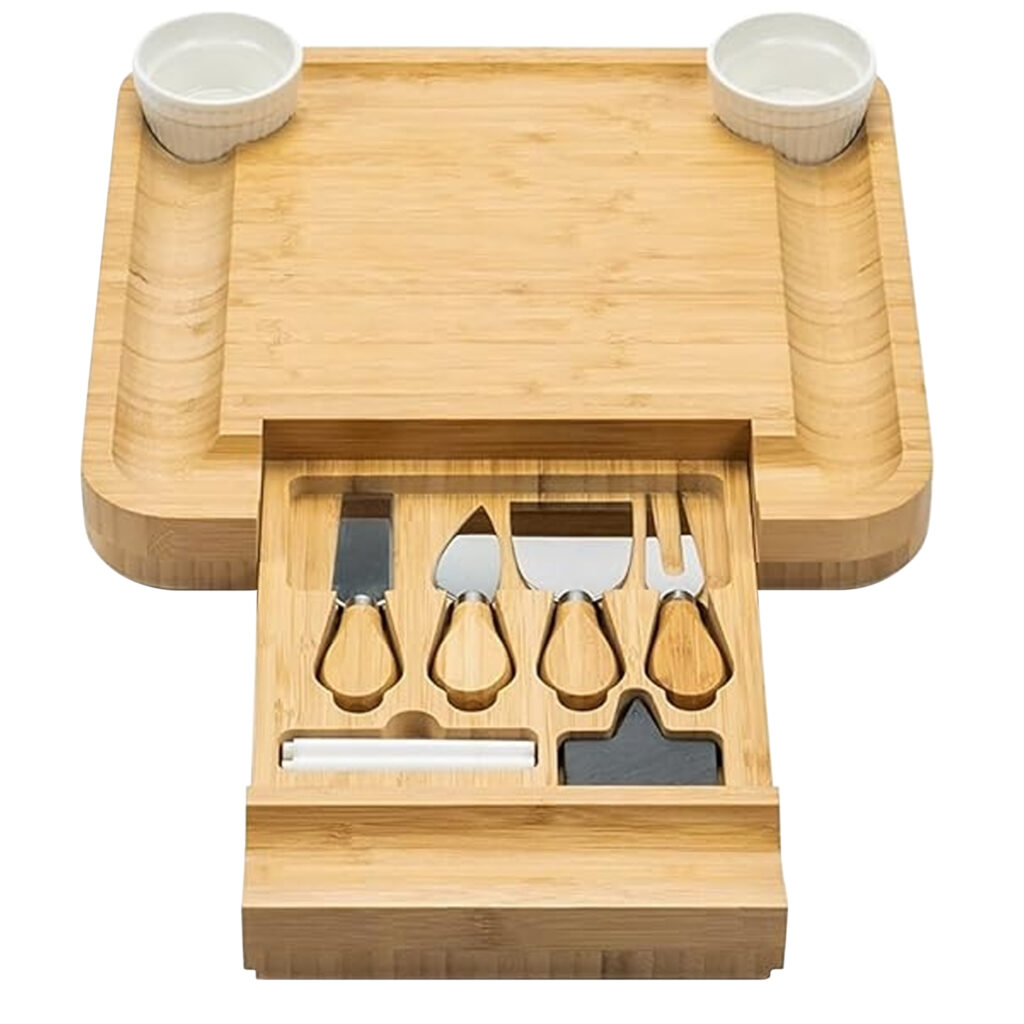
A good dinner-party serving setup gives guests space to reach the food, lets the host move dishes comfortably, and keeps the table usable after everything is set out. Wooden trays, bamboo cheese boards and small bowls can work together, but choosing them only by appearance often leads to crowded tables, awkward handles or a gift set that is difficult to store.
This guide explains how to choose a practical serving assortment for home entertaining, then turns the same decisions into a specification for retailers, hospitality buyers and private-label brands.
Choose the job before choosing the board
A serving board presents food on the table. A tray carries several items between rooms. A rotating platter gives people access from different seats. Those jobs overlap, but the details that make each item useful differ. A flat cheese board may look attractive with glasses on it, yet offer little protection against a glass sliding while someone carries it.
For a small gathering, start with one main serving piece and one separate carrying tray. Add bowls only when dips, olives or other loose items need their own container. For a larger buffet, two smaller boards can make replenishing food easier than lifting one oversized display. Think about where guests stand and how the host will replace a dish without disturbing the whole arrangement.
| Task | Useful starting point | Details to check |
|---|---|---|
| Present cheese and accompaniments | Bamboo cheese board or acacia serving board | Usable surface, accessory layout, cleaning access and storage |
| Carry drinks or dishes | Wooden serving tray with handles | Grip clearance, rim, base, overall weight and intended load |
| Share food across a compact table | Rotating serving platter | Stable base, smooth movement and clearance around tableware |
| Contain dips or dressings | Separate bowls or removable inserts | Fit, removal, cleaning instructions and material suitability |
Measure the usable surface, not just the outer dimensions
The headline dimensions can hide how much space is available for food. Handles, rims, grooves and accessory recesses all reduce the usable area. On a rectangular tray, record the inside base dimensions as well as the outer length and width. On a cheese-board set, check the clear serving area with every accessory in its intended position.
Try a simple layout before purchasing or approving a sample. Place paper shapes representing the board, plates, bowls and glasses on the table. Leave room for diners to reach and for a serving utensil to rest. Then check whether the board fits a cupboard or drawer when the event is over. A product that looks generous in a photograph can be inconvenient in a narrow kitchen.
Retailers can use the same exercise to improve their product listings: show the board beside familiar tableware, state the usable surface dimensions, and photograph how accessories store. These details give shoppers more useful information than a vague description such as “perfect for every party.”
Bamboo or acacia: compare the finished construction
Bamboo can suit a collection with a consistent, understated appearance. Acacia can suit a range built around visible grain and natural color variation. The final choice depends on the sample, construction, finish and price point. Material names alone do not establish durability, food-contact suitability or ease of care.
For a bamboo cheese-board set, review laminate joints, sanding, accessory fit and any moving drawers. For an acacia serving tray, agree the acceptable grain and color range, handle construction and base design. If natural variation is part of the appeal, show that variation honestly in retail photography.
Distinguish direct food contact from carrying plates or bowls. Ask which finish and adhesive are included in the actual quotation and what evidence applies to the intended use and destination. When considering several materials, our kitchenware material comparison provides a broader starting framework.
Make a coordinated hosting set easy to use
A coordinated set does not need many pieces. A board, a carrying tray and a pair of removable bowls can make a clear assortment if each has a distinct role. Repeating the material tone, edge profile and branding position gives the set visual consistency without forcing every item into the same dimensions.
Check the transitions between tasks. Can a bowl be lifted out with wet fingers? Can the tray handles be held without pushing against the dishes? Does the board sit flat when someone cuts or serves? Are utensils accessible after food covers the surface? These small decisions determine whether a product feels comfortable during an actual gathering.
A themed dinner or games night also changes the layout. Keep large serving pieces away from the area used for cards or tiles, and give drinks a separate surface. For outdoor entertaining, choose a stable setup, follow the product’s stated use conditions, and bring natural-material pieces inside to dry and store after use.
Build a private-label assortment around three clear options
For a first retail collection, consider an entry item, a principal hosting item and a gift option. For example, the entry item could be a simple serving board; the principal item a tray or board with a defined feature; and the gift option a coordinated set. Price and order quantities should follow the specified construction and packaging, rather than assumed differences between “basic” and “premium.”
Document the feature that distinguishes each SKU. One might prioritize compact storage, another handle comfort, and another presentation. Avoid adding accessories merely to increase the piece count. Each extra component introduces a fit, finish, sourcing and packaging requirement that the buyer must approve.
- Approve a finish reference and acceptable appearance range across the assortment.
- Set logo size and placement on each item, including the visibility of engraving on different grain patterns.
- List every bowl, knife, insert, magnet or moving part included in the pack.
- Define care information and keep the retail description consistent with the approved intended use.
Inspect the sample with a realistic table setup
Inspect the item visually, then use it in the arrangement it is designed for. Check flatness, edges, base contact, handle comfort and accessory operation. For a carrying tray, agree a suitable load and test method with the manufacturer; do not infer a weight limit from a marketing photograph. For a rotating platter, check movement with the intended layout and confirm that the base remains stable.
Follow the proposed cleaning instructions on a sample and review the result. Ask whether the product is suitable for soaking or dishwasher cleaning before making either claim. Record sample revisions and approve the final pack-out, including protection between accessories and finished surfaces. Our sample approval checklist helps turn these observations into a repeatable record.
Send a brief that produces a comparable quotation
Include the intended sales channel, reference design, material, usable and overall dimensions, quantity per SKU, accessory list, logo and packaging. Add the destination and target delivery date so the factory can identify timing and documentation questions early. Specify whether the quotation covers a board alone or a complete branded set.
Explore our wooden serving-tray program and charcuterie-board sourcing page, or send a hosting-product RFQ with your preferred assortment. A clear use case and complete pack list make the next conversation much more useful.
Editorial source: Google’s July 28, 2026 Trends report identified cocktail- and garden-party hosting searches as trending in the preceding month. Our product-selection guidance connects that dated entertaining theme with practical serving requirements.