
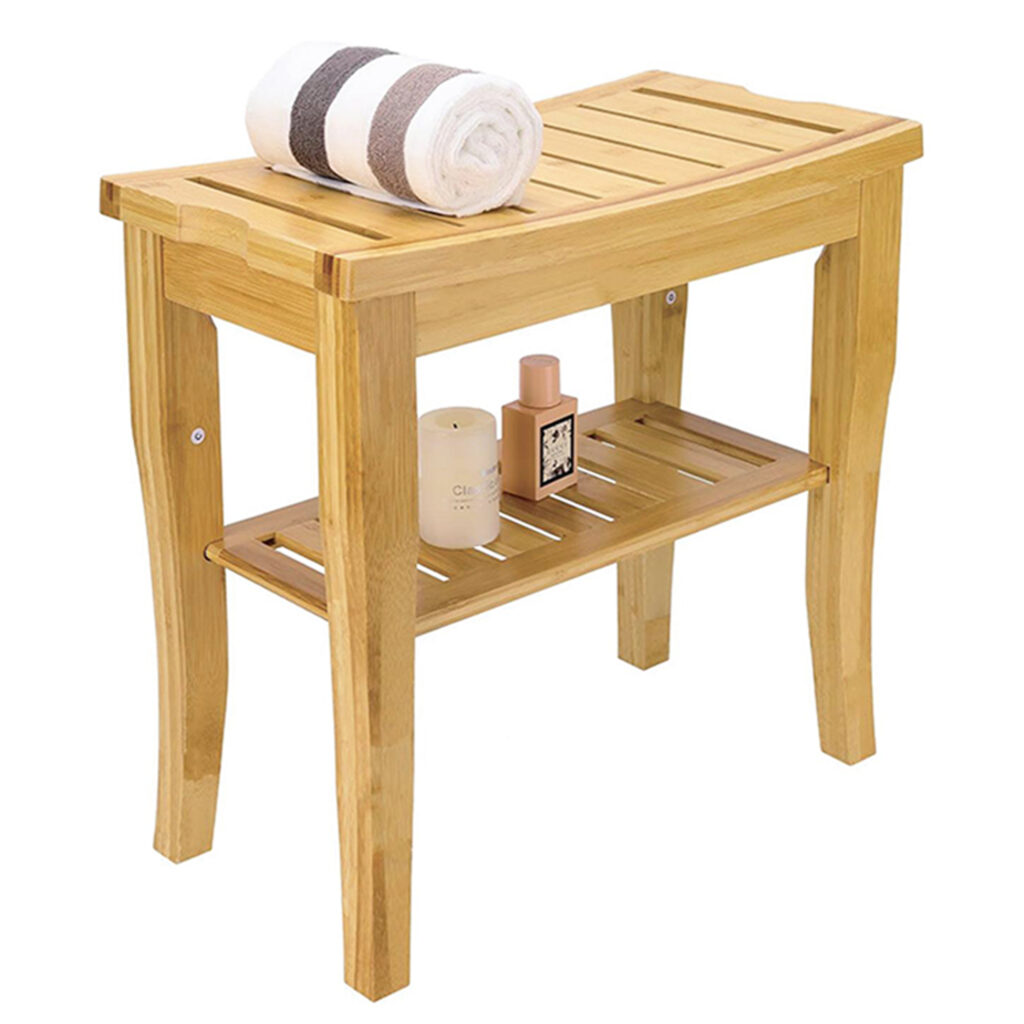
A bamboo bath tray and a bamboo shower bench may sit in the same retail collection, but they do not face the same conditions in use. The tray may be splashed and wiped dry; a bench may need to support a person on a wet floor. A bathroom mat has still another set of drainage and slip considerations. Treating them as one generic “waterproof bamboo” category makes quotations hard to compare and samples hard to approve.
This guide shows importers and private-label teams how to build a product-specific brief before asking a factory to quote. It is a sourcing framework, not a claim that any particular product has passed a load, slip, water-resistance or destination-market test. Those results must be confirmed on the final design.
Start with the actual use environment
Define where the item will stand, how often it will be wet, how it will dry and whether it will carry a load. “Bathroom use” is too broad. A caddy across a bathtub, a stool beside a sink and a shower bench inside a wet enclosure have different exposure and stability questions.
| Product direction | Use questions to answer before quoting | Design points to review |
|---|---|---|
| Bath caddy or tray | Tub-width range? Expected splash? Devices, glasses or candles placed on it? | Adjustment mechanism, end stops, contact pads, drainage and edges |
| Shower bench or stool | Seated use? Wet-floor contact? Target user and load scenario? | Foot grip, stability, joints, load-test plan and cleaning access |
| Bath mat | Inside or outside the shower? Floor type? Frequency of wetting? | Drainage gaps, underside grip, drying and edge treatment |
| Bathroom storage | Standing or wall-mounted? Humid room or direct splash? Assembly by the consumer? | Wall fixing, shelf load, hardware, ventilation and instructions |
Describe normal use and reasonably foreseeable misuse in the brief. In particular, do not present a decorative tray as a seat or a general bathroom rack as a wall-mounted load-bearing product without an appropriate design and test plan.
Specify the material and finish without promising “waterproof” performance
For laminated bamboo products, ask the manufacturer to identify the bamboo construction, adhesive system, surface treatment and any mixed materials or hardware. The approved sample should establish the acceptable color range, surface feel, visible joints and repair policy. Specify whether the finish is intended for occasional splash, frequent wiping or a wetter environment, then agree how it will be evaluated. A finish can affect moisture exchange; it should not be described as making a natural-material product permanently waterproof.
The US Forest Service Wood Handbook chapter on moisture relations explains why wood responds to surrounding humidity and temperature and why dimensional stability matters when moisture conditions vary. Bamboo laminate has its own construction and adhesive behavior, so do not copy a solid-wood moisture percentage into every bamboo SKU. Instead, agree on the measurement method, sample locations, acceptance range and conditioning stage for the actual product.
- Record material grade, laminate direction, component thickness and permitted appearance variation.
- Identify adhesive, coating, oil or other finish by specification; request evidence relevant to the finished product and market.
- Define the exposure scenario and cleaning instructions the label will actually communicate.
- Set a moisture or dimensional acceptance method for the approved construction, rather than one universal number.
For a broader explanation of humidity and movement, see our wood moisture and product stability guide.
Make dimensions and stability measurable
A reference photo establishes appearance, not fit. Send a dimensioned drawing that marks overall length, width and height, critical spans, thickness, drainage gaps, contact points and any adjustable range. State which dimensions are functional and need tighter tolerances. On a bath caddy, the critical fit may be the usable tub-width range and the security of its end contact. On a bench, leg geometry, floor contact, joint integrity and the intended load scenario matter more than a cosmetic width measurement.
For products intended to support a person or remain stable on wet surfaces, involve a qualified product-safety or test specialist in defining the test method and acceptance criteria. A generic factory statement such as “strong enough” is not a test report. Agree what is tested, how many samples are tested, what constitutes failure, and whether the final production construction matches the tested sample.
Review our bamboo shower bench and bamboo bath caddy program as starting directions. Their published dimensions are references for discussion, not proof that a customized version meets a buyer’s target performance.
Approve a collection as a system, not a set of isolated SKUs
Private-label bathroom ranges often fail visually even when each individual sample is acceptable. Two “natural bamboo” items can differ in color, grain orientation, sanding feel or hardware finish. Build a collection specification alongside the SKU drawings. It should identify a shared finish reference, permitted color variation, logo size and placement, label hierarchy, packaging graphics and any accessory or hardware finish.
Keep product-level requirements separate. A common collection appearance does not mean a bath mat, caddy and bench should share one load, slip or water-exposure claim. Approve one pre-production sample for each SKU and record the collection-level comparison with photographs taken under consistent lighting.
Plan packaging for the actual sales channel
Packaging must protect the final finish and the parts most likely to move or contact the carton: caddy rails, bench legs, mat edges, metal hardware and separately packed accessories. A retail shelf carton and a parcel-shipping carton face different handling. Ask for a packing drawing that shows each component, protective layer, retail pack, master carton quantity, marks and assembly instructions.
The International Safe Transit Association’s test-procedure guidance distinguishes design-screening tests from distribution simulations and advises selecting a procedure that matches the actual shipment route. Do not claim an ISTA pass without a report for the finished packaged product. When a retailer or marketplace specifies a protocol, include that requirement before finalizing the carton.
- Confirm whether the item ships assembled, knocked down or nested.
- Protect corners, finished faces and hardware against rubbing in transit.
- Show the destination-market language, care instructions, barcode and any required warnings on approved artwork.
- Test a production-representative packaged sample against the buyer’s distribution route.
A buyer-ready RFQ and sample-approval checklist
Send the same written brief to every shortlisted supplier. That lets buyers compare like-for-like quotations rather than comparing one standard SKU with another supplier’s customized, tested retail pack.
| Item | Buyer should provide or request |
|---|---|
| Product and use | SKU list, reference images, intended location, wetting frequency, user and load scenario |
| Construction | Dimensioned drawings, material, laminate, joints, hardware, adjustment and assembly |
| Acceptance | Critical tolerances, appearance range, finish, conditioning, stability and product-specific test plan |
| Brand program | Logo artwork, collection color reference, labels, care and assembly instructions |
| Packaging | Sales channel, protective design, carton quantity, distribution-test requirement and destination |
| Commercial scope | Quantity per SKU, sample plan, target date, trade term and quotation assumptions |
Before approving mass production, compare the sample with the drawing, test plan, finish reference, package artwork and actual pack-out. Record deviations and revisions in writing. If construction, hardware, coating or packaging changes after approval, reassess the affected tests and obtain a new approval where needed.
What to ask the factory next
Ask which construction and exposure scenario the factory is quoting, which attributes can be verified on a sample, and which tests need an independent laboratory or destination-market review. Request product-specific evidence rather than a generic certificate bundle. See our quality-control process and EU/US compliance planning guide for the broader evidence framework.
If you are developing a coordinated bathroom range, send us a reference image or drawing, SKU mix, quantities, destination market and packaging channel through the manufacturing inquiry page. We can review feasibility and identify what must be confirmed before an accurate quotation.